结核与肺部疾病杂志 ›› 2026, Vol. 7 ›› Issue (3): 356-362.doi: 10.19983/j.issn.2096-8493.20260015

• 论著 • 上一篇    下一篇

基于Joinpoint回归及时间序列模型的重庆市梁平区2011—2025年肺结核报告发病趋势及预测研究

廖影, 陈曦, 陈功, 陈静, 赵静, 何高琴, 游茂林, 涂龙成()   

  1. 重庆市梁平区疾病预防控制中心疾病预防控制科, 重庆 405200
  • 收稿日期:2025-11-29 出版日期:2026-06-20 发布日期:2026-06-12
  • 通信作者: 涂龙成 E-mail:36542651@qq.com
  • 基金资助:
    重庆市梁平区-璧山区协作科研项目(BSKJ2023068);重庆市疾病预防控制局科研项目(2026JKXM025)

Analysis of trends and forecasting of reported pulmonary tuberculosis incidence in Liangping District, Chongqing from 2011—2025 based on Joinpoint regression and time series models

Liao Ying, Chen Xi, Chen Gong, Chen Jing, Zhao Jing, He Gaoqin, You Maolin, Tu Longcheng()   

  1. Department of Disease Control and Prevention, Liangping District Center for Disease Control and Prevention, Chongqing 405200, China
  • Received:2025-11-29 Online:2026-06-20 Published:2026-06-12
  • Contact: Tu Longcheng E-mail:36542651@qq.com
  • Supported by:
    Chongqing Liangping District-Bishan District Collaborative Research Project(BSKJ2023068);Chongqing Municipal Bureau for Disease Control and Prevention Research Project(2026JKXM025)

摘要:

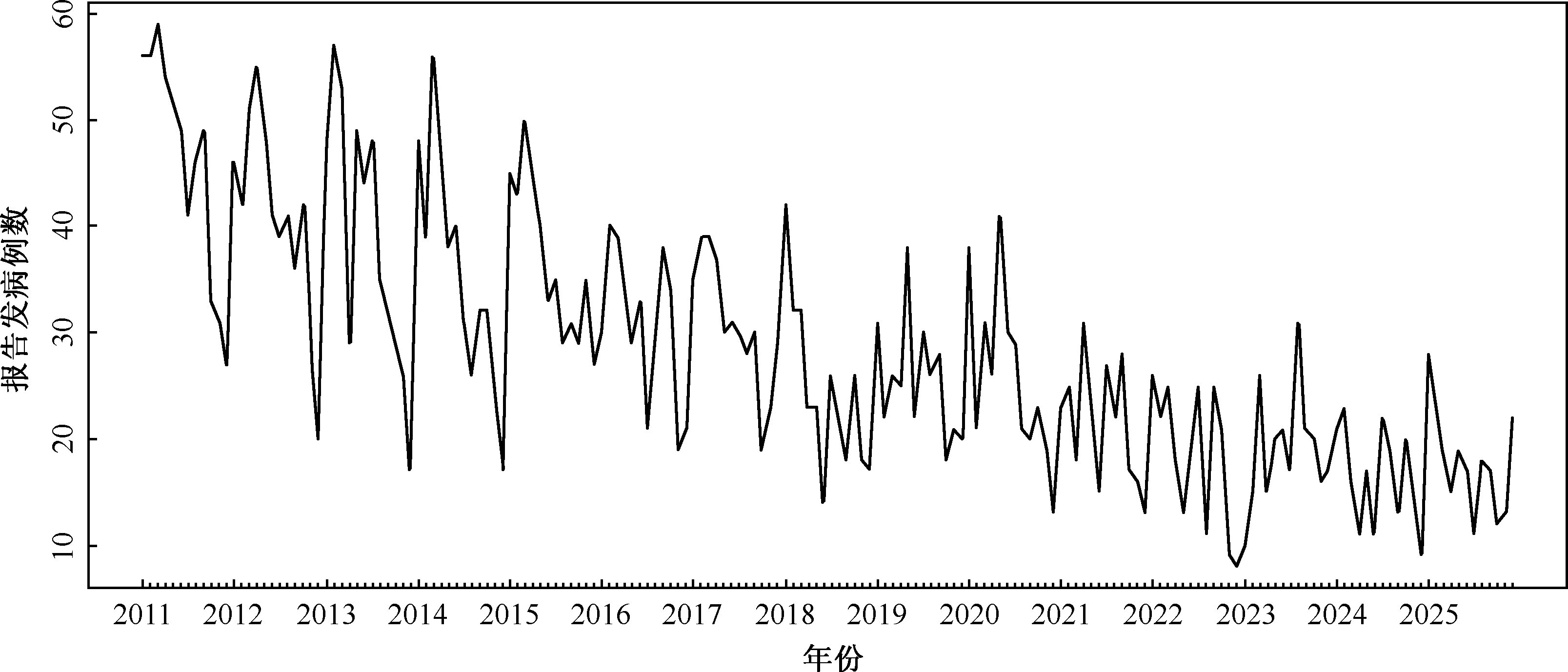
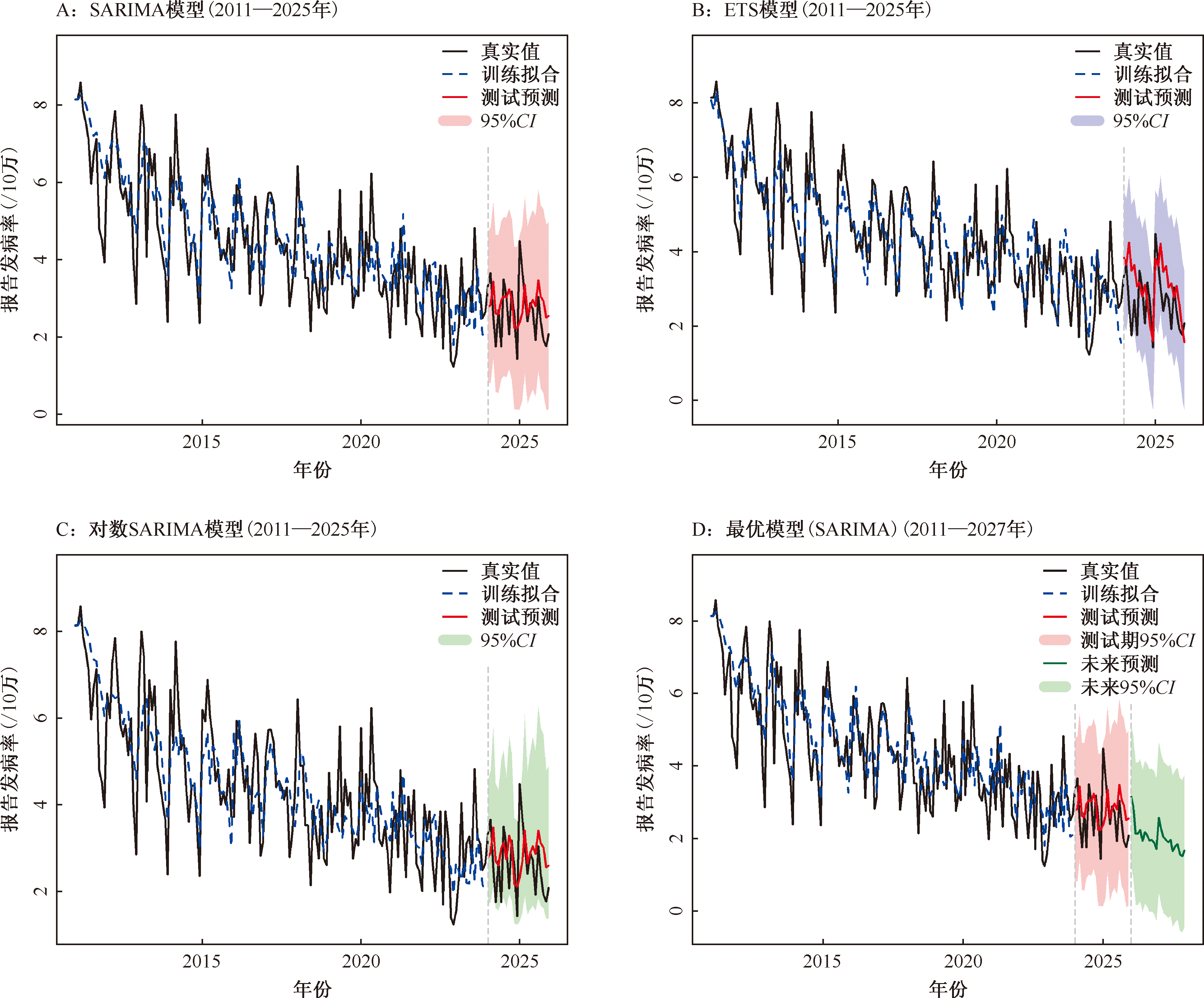
目的: 分析2011—2025年重庆市梁平区肺结核发病长期趋势,并比较不同时间序列模型的预测性能,以为“无结核区县”创建的精准防控提供科学依据。方法: 从“中国疾病预防控制信息系统”子系统“传染病监测”中收集2011—2025年重庆市梁平区肺结核年度及月度报告发病数据及人口学数据,应用Joinpoint回归模型分析肺结核年度报告发病率的长期趋势,并计算年度变化百分比(APC)和月度变化百分比(MPC)及其95%置信区间(CI)。以2011—2023年肺结核月报告发病率数据作为训练集,使用 R 4.5.2软件构建季节性差分自回归移动平均(SARIMA)模型、指数平滑(ETS)模型及对数变换SARIMA模型,以2024—2025年数据作为测试集评价模型的预测效果,并根据均方根误差(RMSE)、平均绝对百分比误差(MAPE)选出其中的最优模型,并以此预测2026—2027年肺结核月报告发病率。结果: 2011—2025年,梁平区累计报告肺结核患者5151例,年均报告发病率为51.21/10万(5151/10059411),月均报告发病率为4.26/10万(5151/120848683),年度报告发病率从2011年的80.44/10万(553/687498)下降至2025年的34.26/10万(214/624635)。Joinpoint回归分析显示,梁平区肺结核年度报告发病率总体呈下降趋势(APC=-6.14%,95%CI:-6.85%~-5.42%,t=-17.998,P<0.001)。经R 4.5.2软件对训练集月报告发病率数据进行3种时间序列模型的自动建立和筛选,分别获得SARIMA(5,1,1)(2,0,0)[12]、ETS(A,Ad,A)和对数变换SARIMA(0,1,1)(2,0,0)[12]最优模型,经测试集模型拟合计算RMSEMAPE数值,发现SARIMA(5,1,1)(2,0,0)[12]模型表现出最佳的预测性能,其RMSEMAPE分别为0.798和27.016%。该模型的测试及预测结果显示,2024—2027年梁平区肺结核月报告发病率呈缓慢下降趋势(MPC=-1.11%,95%CI:-1.57%~-0.66%,t=-4.916,P<0.001)。结论: 2011—2025年梁平区肺结核报告发病率呈下降趋势,防控成效显著。SARIMA(5,1,1)(2,0,0)[12]模型对该地区肺结核月发病率具有较好的短期预测能力,并提示梁平区需在后续防控中采取更积极的干预策略,为本区“无结核区县”创建的动态监测与预警提供确切的方法学支持。

关键词: 结核,肺, 模型,统计学, 统计学分布, 回归分析, 发病率, 预测

Abstract:

Objective: To analyze the long-term trends of pulmonary tuberculosis (PTB) incidence in Liangping District, Chongqing from 2011—2025, and to compare the predictive performance of different time series models, thereby providing a scientific basis for precision prevention and control in the context of establishing a “tuberculosis-free district”. Methods: Annual and monthly reported PTB incidence data and demographic data in Liangping District from 2011 to 2025 were collected from the “Infectious Disease Surveillance” subsystem of the “China Disease Prevention and Control Information System”. Joinpoint regression was applied to analyze the long-term trend of annual reported incidence, and the annual percent change (APC), monthly percent change (MPC), and their 95% confidence intervals (CI) were calculated. Using monthly reported PTB incidence data from 2011 to 2023 as the training set, and R 4.5.2 software to automatically select optimal models, three models were constructed: seasonal autoregressive integrated moving average (SARIMA), error-trend-seasonal (ETS), and log-transformed SARIMA. The data from 2024 to 2025 were used as the test set to evaluate the predictive performance of the models. The optimal model was selected based on the root mean squared error (RMSE) and mean absolute percentage error (MAPE), and was then used to forecast the monthly reported PTB incidence for 2026—2027. Results: From 2011 to 2025, a total of 5151 PTB cases were reported in Liangping District, with an annual average reported incidence of 51.21/100000 (5151/10059411) and a monthly average reported incidence of 4.26/100000 (5151/120848683). The annual reported incidence decreased from 80.44/100000 (553/687498) in 2011 to 34.26/100000 (214/624635) in 2025. Joinpoint regression showed an overall downward trend in the annual reported incidence of PTB in Liangping District (APC=-6.14%, 95%CI: -6.85% to -5.42%, t=-17.998, P<0.001). Using R 4.5.2 software, the three optimal models were automatically established and selected from the training set: SARIMA(5,1,1)(2,0,0)[12], ETS(A,Ad,A), and log-transformed SARIMA(0,1,1)(2,0,0)[12]. Based on the RMSE and MAPE calculated on the test set, the SARIMA(5,1,1)(2,0,0)[12] mode exhibited the best predictive performance, with RMSE=0.798 and MAPE=27.016%. The testing and forecasting results of this model indicated that the monthly reported PTB incidence in Liangping District from 2024 to 2027 showed a slowly decreasing trend (MPC=-1.11%, 95%CI: -1.57% to -0.66%, t=-4.916, P<0.001). Conclusion: From 2011 to 2025, the reported incidence of PTB in Liangping District showed a downward trend, indicating remarkable achievements in prevention and control. The SARIMA(5,1,1)(2,0,0)[12] model demonstrates good short-term predictive capability for monthly PTB incidence in this area, and suggests that more proactive intervention strategies are needed in subsequent prevention and control efforts in Liangping District. This provides solid methodological support for dynamic surveillance and early warning in the creation of a “tuberculosis-free district”.

Key words: Tuberculosis, pulmonary, Models, statistical, Statistical distributions, Regression analysis, Incidence, Prediction

中图分类号: